
ProQuantum – Process Development for a Saxon Spin Qubit Pilot Line

ProQuantum – Process Development for the Saxon Spin-Qubit Pilot Line

Project duration: 03/2026 – 12/2027
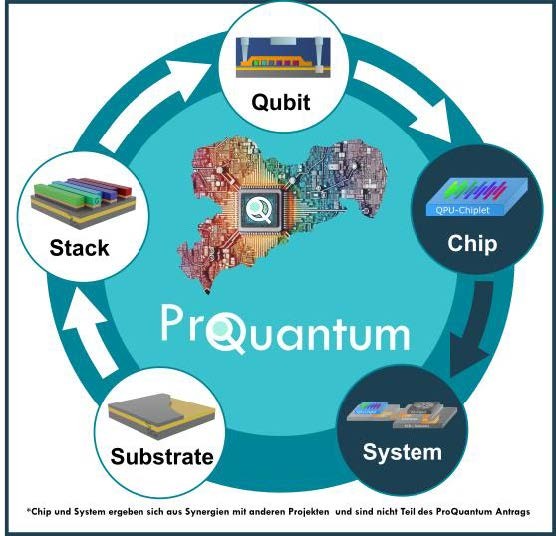
© Fraunhofer IPMS
Overview of the technology modules (substrate, stack, qubit) of the ProQuantum project. Technologies highlighted in dark blue are not part of the project.
© Matthias Künne (Forschungszentrum Jülich, RWTH Aachen),
3D representation of a QuBus (a) and its operating principle (b). Based on this element, a tile-based architecture (d) can be created, enabling rapid scaling (c).
  • The collaborative project ProQuantum, coordinated by Fraunhofer IPMS, focuses on the research and development of industry-compatible manufacturing processes for highly scalable quantum processors.
  • Quantum key technologies are fundamentally transforming medical research, materials development, and system optimization. To ensure a resilient European value chain for next-generation quantum hardware, ProQuantum lays the foundation for a Saxon pilot production line for spin-qubit-based quantum computers as well as a regional quantum computing competence center.


Project goal: from laboratory scale to industrial manufacturing

Fraunhofer IPMS acts as a key interface between Saxony’s substrate production, chip fabrication, and system integration.

Current quantum architectures often face technological scaling limits. ProQuantum therefore focuses on silicon spin qubits, which are based on the control of electron spins in nanoscale quantum dots and offer a major advantage: they are fully compatible with established CMOS manufacturing processes in the semiconductor industry. This enables cost-efficient mass production and extremely high integration densities on chip.


Overview:

  • Process optimization (200 mm): Research into optimized gate stacks on an existing 200 mm research line to minimize charge noise.
  • Scaling (300 mm): Transfer of the technologies to industrial 300 mm wafers to enable future high-density system integration.
  • Rapid characterization: Development of innovative measurement methods for fast quality and defect evaluation of qubit structures..

Work packages

The technological challenges are addressed in three closely interlinked work packages (WP) to ultimately demonstrate a complete integration route for silicon spin qubits:

WP1: Process optimization on 200 mm wafers

To significantly improve qubit quality (fidelity), charge noise in the gate oxide must be minimized.

  • Gate oxide development: Use of novel hafnium (Hf)- and zirconium (Zr)-based dielectrics with a low thermal budget
  • Gentle etching processes: Development of defect-minimizing wet chemical cleaning and dry etching techniques to protect sensitive layers
  • Superconducting electrodes: Integration of CMOS-compatible superconducting nitrides (such as HfN, TiN, and ZrN) into the gate stack


WP2: Process transfer to the 300 mm technology node

True scaling to thousands of qubits requires transition to industrial 300 mm wafer formats.

  • 2DEG substrate development: Evaluation of regional suppliers in Saxony for advanced Si/SiGe heterostructures
  • Cross-tool process transfer: Adaptation of deposition, etching, and cleaning processes to the changed chamber geometries of 300 mm industrial tools
  • Advanced lithography: Combination of DUV and electron-beam lithography (e-beam) for gate structures with minimal pitch (< 80 nm) and alignment accuracy down to 10 nm


WP3: Rapid characterization of spin-qubit processes

A reliable pilot line requires extremely precise and fast defect and failure analysis.

  • Noise measurements & defect analysis: Application of advanced methods such as charge pumping and conductance measurements for precise energetic identification of atomic-scale defects
  • Modeling: Development of temperature-dependent models to accelerate process evaluation


Future perspectives and economic impact

ProQuantum secures a technological leadership position for Saxony and Germany in the global quantum race.

  • Benefits for industry: Commercial customers and foundries gain access to a scalable and reliable gate module. Technological know-how can be licensed flexibly to partners such as Infineon.
  • Ecosystem synergies: The open pilot platform creates a unique infrastructure available to universities, start-ups, and SMEs under fair conditions (contributing to UN Sustainable Development Goal SDG 9).
  • Future workforce: Integration of research outcomes into academic training helps build the next generation of quantum experts directly in Saxony.

Further information:


Geförder durch


Gefördert durch


Quantum Technologies

Quantum Computing


Components and Systems

COMPUTING

Storage technology, data storage, and 300 mm technology modules