
Ferroelectric hafnium oxide varactors for tunable active millimeter wave devices

Project FerroTUNE

Duration: 2025 - 2026
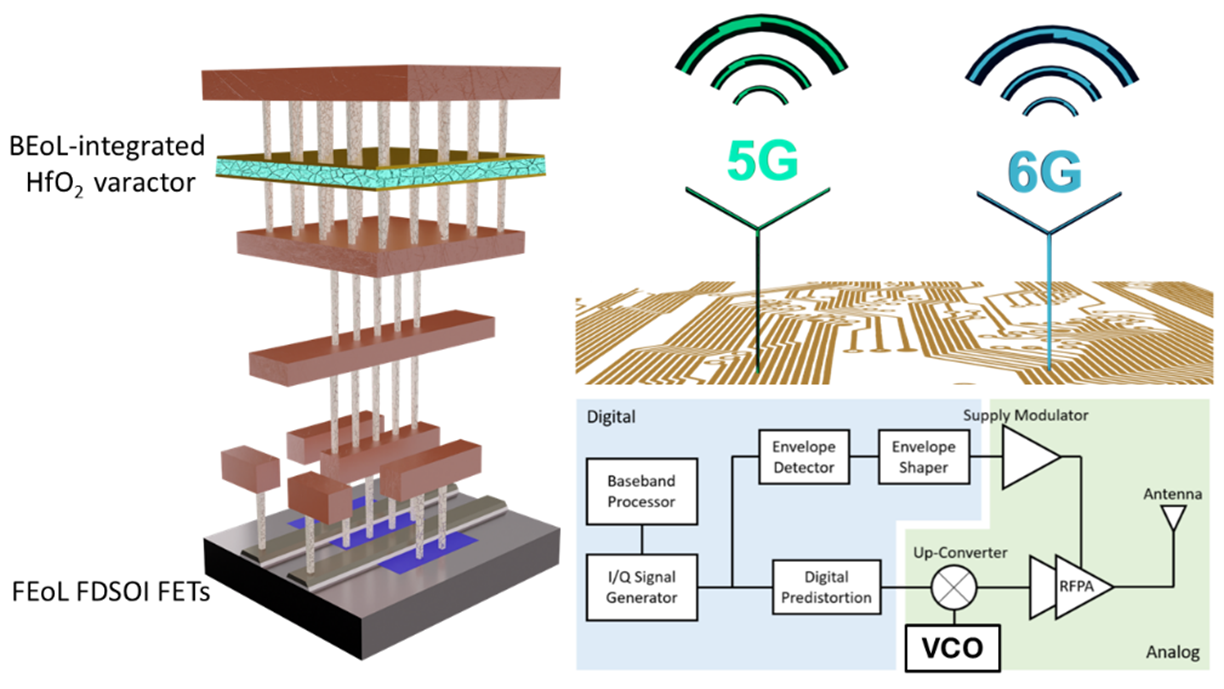
Schematic of BEoL integration of ferroelectric HfO2 into conventional CMOS technology. This allows it to be used for the development of active devices such as oscillators, which are important components in RF and mmWave networks and have potential applications in 5G and 6G technologies.
© FerroTUNE
Schematic of BEoL integration of ferroelectric HfO2 into conventional CMOS technology. This allows it to be used for the development of active devices such as oscillators, which are important components in RF and mmWave networks and have potential applications in 5G and 6G technologies.

In the FerroTUNE project, Fraunhofer IPMS is developing innovative high-frequency components based on ferroelectric hafnium oxide (HfO₂). The aim is to create integrated varactors that can be embedded in modern RF-CMOS systems and enable analog modulation of high-frequency signals. These novel components are intended to help make wireless communication technologies such as 5G and 6G significantly more powerful and energy-efficient.

The project focuses on the development of a voltage-controlled oscillator, which is crucial for signal generation and modulation. It ensures synchronization, low-latency communication, and stable signal generation across multiple frequency bands. These characteristics are essential for modern wireless networks such as 5G and the emerging 6G.

In addition, further applications are opening up in phase shifters, radar systems, satellite communications, and in the field of the Internet of Things (IoT).

Fraunhofer IPMS in the FerroTUNE project

In this project, Fraunhofer IPMS is developing and validating devices based on ferroelectric thin-film hafnium oxide varactors. The primary active component for demonstration purposes will be a voltage-controlled oscillator (VCO).

The main areas of focus are:

  • Chip design and implementation: Development of active high-frequency components such as oscillators and phase shifters in CMOS technology, with a view to compact, high-performance implementation
  • BEoL integration and validation: Integration of hafnium oxide varactors into the back-end-of-line (BEoL) layers of CMOS manufacturing, coordination with industrial customers for subsequent production
  • Characterization: Research into how well these components perform at high frequencies, how well they can be controlled, and how reliably they withstand temperature changes
  • System integration: Integration of the components into circuits and close coordination with partners for real-world application testing

Our goal is to advance to integrated chip systems with a maturity level of TRL 5.

The use of ferroelectric hafnium oxide enables greater energy efficiency to be achieved. The components are miniaturized and less susceptible to temperature fluctuations. Increased linearity in tuning also leads to significant advances in component architecture. Since they can also be manufactured using CMOS technology, which is the industrial standard in microelectronics manufacturing, the result is ideal scalability and cost efficiency.

Further information

Fraunhofer IPMS

300 mm Microelectronics and Nanoelectronics: RF Characterization


Gefördert durch