Press Releases

Cancel
  • OASYS subproject A1 drives innovation in hyperspectral imaging / 2026

    Compact AI-based hyperspectral camera enables new industrial applications

    Press Release / January 20, 2026

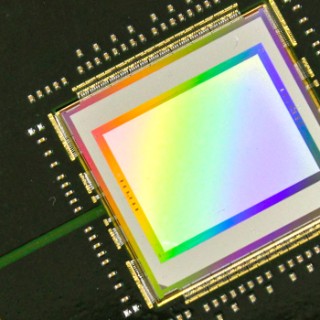
    The OASYS project focuses on optoelectronic sensors for application-oriented systems. In the subproject A1 a team of scientists and industry experts is developing an ultra-compact, energy-efficient hyperspectral camera that uses artificial intelligence to perform complex material and quality analyses in real time. The integrated spectrometer records spectral characteristics, revealing chemical properties that are invisible to the human eye. This enables defects in food or the composition of textiles or plastics to be identified quickly and accurately.

    more info
  • Revolutionary chips for materials research / 2026

    Fraunhofer IPMS closes gap in the characterization of organic semiconductors

    Press Release / January 15, 2026

    The Fraunhofer Institute for Photonic Microsystems IPMS has developed innovative chips that are revolutionizing the characterization of organic materials and accelerating the development of new electronic applications. A newly developed measuring adapter allows for the first time simultaneous contact with up to eight interdigital electrode pairs, setting new standards in precise material analysis. In the context of the growing demand for flexible and efficient technologies, these high-precision measurement methods will be instrumental in improving the performance of future electronic systems.

    more info
  • The Fraunhofer Institute for Photonic Microsystems IPMS is collaborating with the Max Planck Institute for Chemical Physics of Solid States CPfS on an innovative project called "OptoQuant." This project is funded under the Fraunhofer-Max Planck cooperation program and aims to develop CMOS-integrated micro-optoelectronic quantum sensors for highly sensitive magnetic field imaging at room temperature. Initial results will be presented as a talk at SPIE Quantum West 2026 and at SPIE AR/VR/MR 2026 (January 20-22, 2026, booth number 6429, in San Francisco, USA) with an exhibit.

    more info
  • Quantum sciences and applications are rapidly advancing as key technologies for secure communication, high-performance computing, new materials, and ultra-precise sensing. To strategically advance these future technologies and transfer them into industrial applications, the Saxon research network for quantum technologies, SAX-QT “Quantum Saxony”, is being launched today. The aim is to strategically pool, further develop, and make internationally visible the expertise in quantum technologies within the Free State of Saxony. The network is coordinated by Zittau/Görlitz University of Applied Sciences, the Fraunhofer Institutes for Photonic Microsystems IPMS and for Machine Tools and Forming Technology IWU, and the Leibniz Institute for Solid State and Materials Research IFW Dresden.

    more info
  • Fraunhofer IPMS launches project AIS Edge Node / 2025

    Innovative sensor technology for sustainable transformation in Lusatia

    Press Release / December 09, 2025

    The Fraunhofer Institute for Photonic Microsystems (IPMS) has launched the AIS-Edge Node project (Adaptive Integrated Inline Sensors for Infrastructure in the Environmental and Hydrogen Economy), working alongside numerous regional partners. The project aims to contribute significantly to structural change in Lusatia by utilising innovative sensor technologies and AI-based evaluation methods. The project will focus on closely monitoring soil and water bodies, as well as providing reliable safety monitoring for the growing hydrogen economy.

    more info
  • Fraunhofer IPMS drives innovation in medical and industrial imaging through OASYS project / 2025

    High-Tech Imaging in Scattering Media for Medical Applications

    Press Release / December 04, 2025

    In the OASYS joint project, Optoelectronic Sensors for Application-Oriented Systems for Life Sciences and Intelligent Manufacturing, Fraunhofer Institute for Photonic Microsystems IPMS is collaborating with research and industry partners to develop state-of-the-art optoelectronic sensor technologies. A key focus is given to the flagship project B1, MEMS-based Imaging in Scattering Media, which employs novel spatial light modulators (SLMs). These enable precise control of the light phase in highly scattering environments, enabling accurate wavefront correction and high-resolution imaging for biomedical diagnostics.

    more info
  • Artificial intelligence works fast, but its energy consumption is growing rapidly. A German-Taiwanese research team is now developing a solution: new memory for leading chip technologies smaller than 3 nm. These innovative nanosheet devices enable computing operations directly in memory, thereby drastically reducing energy consumption. They are based on ferroelectric field-effect transistors (FeMFETs) made from hafnium oxide, which are particularly efficient. With a joint research program, Fraunhofer IPMS, Fraunhofer IMWS, and the Taiwanese research institute TSRI are laying the foundation for the next generation of energy-efficient AI chips – from smartphones and automobiles to medical devices.

    more info
  • New Key Management System (KMS) for Secure Communication in the Future / 2025

    Fraunhofer IPMS Develops Key Management System (KMS) for Quantum-Secure Networks

    Press Release / November 27, 2025

    The Fraunhofer Institute for Photonic Microsystems IPMS has developed a new key management system (KMS) specifically designed for use in quantum-secure networks. The system enables the secure exchange of secret keys and ensures reliable, secure data distribution across large-scale network infrastructures.

    more info
  • QSolid Project Marks a Key Milestone for Germany’s Quantum Ecosystem / 2025

    QSolid Quantum Computer Now Accessible to External Users

    Press Release / November 25, 2025

    Scientists at Forschungszentrum Jülich, together with partners from the QSolid consortium, which includes the Fraunhofer Institute for Photonic Microsystems IPMS, have achieved a significant project milestone: the project team has successfully integrated the prototype of a quantum computer into the Jülich Supercomputing Centre’s infrastructure, known as JUNIQ. For Fraunhofer IPMS as an active project partner, this progress represents a significant milestone on the path to a powerful and trustworthy German quantum ecosystem.

    more info
  • CEASAX presents pioneering 300 mm technologies - From research to pilot manufacturing / 2025

    “From Lab to Fab” – Innovative front-end and advanced packaging technologies for the semiconductor value chain

    Press Release / November 18, 2025

    The Fraunhofer Center for Advanced CMOS and Heterointegration Saxony (CEASAX) is driving forward the development of pioneering technologies for microelectronics and has established itself as a key player in the European semiconductor value chain. Through its participation in the APECS pilot line, a core project of the EU Chips Act, and in the TEF project PREVAIL as part of the Digital Europe Program, CEASAX ensures access to cutting-edge technologies and supports stable supply chains in the field of advanced packaging at the 300 mm industry standard. Innovations in chiplet integration offer unique opportunities for smaller, more powerful and more efficient packages at the wafer level.

    more info