
Quantum Computing

Quantum computing “Made in Europe”: Fraunhofer IPMS conducts research on superconducting qubits, spin qubits, photon-based qubits and neutral atom qubits

Fraunhofer IPMS is actively shaping the future of quantum technologies. Our work focuses on the development of scalable quantum computer hardware, ranging from materials research to industrial integration. With our 200 mm and 300 mm semiconductor manufacturing facilities, our expertise in photonics, nanoelectronics, and microsystems technology, and our close cooperation with industry partners, we are building a bridge between research and application.

The European Commission's Quantum Europe Strategy calls for securing Europe's leadership in quantum computing, quantum communication, and quantum sensing. Fraunhofer IPMS is making a decisive contribution to this: We develop and test key technologies that contribute to a sovereign European quantum value chain – from basic research and process integration to industry-ready prototypes.

Our focus is on the four central hardware platforms of quantum computing: superconducting qubits, neutral atoms, photonic qubits, and semiconductor-based spin qubits. In doing so, we support Europe's strategic goals – scalability, sustainability, and technological sovereignty – and drive the development of the next generation of quantum processors “Made in Europe.”
1. Superconducting qubits

Quantum computing

Superconducting qubits are electrical circuits made of superconducting materials that operate at extremely low temperatures. They are controlled using microwave pulses. Due to their compatibility with the prevailing processes in the semiconductor industry, they are one of the most promising technologies for quantum computers. Fraunhofer IPMS leverages its expertise in state-of-the-art, industry-compatible CMOS semiconductor manufacturing in the 300 mm wafer standard. Focus: Deposition, nanostructuring, electrical characterization, cryogenic control electronics, optimized metallization, and BeoL modules for superconducting qubits.

Projects & pilot lines:

Pilot line

SUPREME

SUPREME is an important European pilot line for the industrialization of superconducting quantum chip manufacturing.

Pilot line

Qu-Pilot

Pilot production capabilities for quantum technologies

2023 - 2026

Research project

QSolid

Quantum computer in the solid state

2021 - 2026

Research project

ARCTIC

Scalable cryogenic control technology for quantum processors

2024 - 2027

Research project

MATQu

Materials for quantum computing (completed)

2021 - 2024

2. Semiconductor-based spin qubits

Quantum computing

Here, the spin of an electron in a semiconductor device (e.g., silicon) serves as a qubit. Semiconductor-based qubits are a promising type of qubit for quantum computers because they are based on the same materials and manufacturing processes as conventional chips. By using known CMOS manufacturing methods, these qubits can potentially be miniaturized and integrated in large numbers. A key advantage is the ability to integrate the control electronics directly on the chip, which enables scalability and could facilitate the manufacture of larger and more powerful quantum computers.

Fraunhofer IPMS is participating by utilizing adapted processes from CMOS manufacturing. The focus is on using our state-of-the-art 300 mm CMOS cleanroom to provide technology improvements for scalable quantum computing.

Projects & pilot lines:

Pilot line

Qu-Pilot

Pilot production capabilities for quantum technologies

2023 - 2026

Research project

QLSI

Scalable silicon qubits for quantum computers

2024 - 2027

Research project

QUASAR

Innovative manufacturing methods for scalable qubits (completed)

2021 - 2025

3. Photon-based qubits

Quantum computing

Photonics qubits use light particles (photons) to store and process information. This technology is promising because it often operates at room temperature. In addition, photons can be transmitted over long distances in fiber optic cables and are less susceptible to environmental influences.

Fraunhofer IPMS develops integrated, monolithic control technologies for the optoelectronic components of photonic quantum computers, as well as assembly and connection technology.

4. Qubits in neutral atoms

Quantum computing

Neutral atom qubits use electrically neutral atoms as quantum bits. They are trapped in optical traps and controlled by lasers to perform calculations and generate entanglement. This approach offers advantages such as high scalability and long coherence times.


Fraunhofer IPMS develops spatial light modulators (SLMs) for the programmable modulation of light intensity or phase. To enable scalable and efficient quantum computing processes, these components must also be suitable for specific wavelength ranges (such as the UV range). In addition, they must enable fast and extremely accurate light modulation. Fraunhofer IPMS offers phase-shifting, diffractive dip mirror MEMS SLMs that open up new dimensions in terms of precision and scalability. 

In addition to developing application-specific MEMS area light modulators, Fraunhofer IPMS also offers pilot production of the new components in the institute's own clean room using industry-standard processes. This ensures that a sufficient number of area light modulators are available for the first product series following a development project. For high volumes, IPMS also supports the transfer of the process to an external commercial MEMS foundry.

Paper: Dynamical spatial light modulation in the ultraviolet spectral range (Physical Review Applied)


Value chain in quantum computing

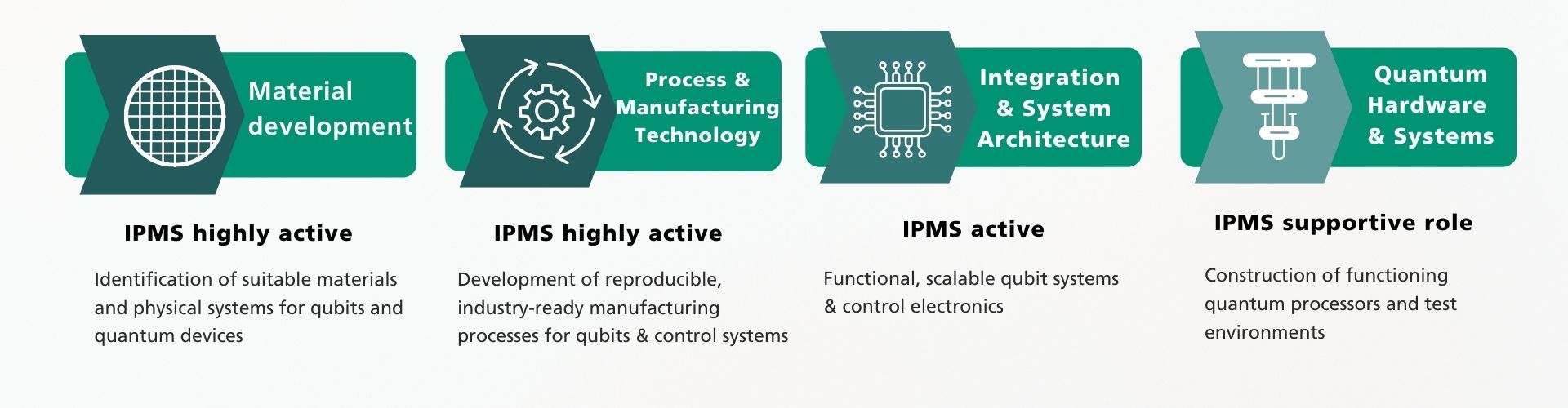
Fraunhofer IPMS is active along the entire value chain. One of our particular areas of expertise lies in materials development, cryoelectronics, and characterization, as well as process and manufacturing technology with our 300 mm CMOS line. We also conduct research into integration and connection technology, as well as control electronics. Fraunhofer IPMS supports quantum hardware as a component and process supplier.

Webinars

Quantum computing


Webinar

Advanced Technology and Hardware for Next Generation Computing


Webinar

Leveraging Semiconductor Manufacturing

for large-scale Quantum Computing Technology

Networks & memberships:

Quantum computing


Wesbite

SAX-QT

Saxon Network for Quantum Technologies


Fraunhofer IPMS plays a coordinating role within Quantum Saxony. As an interface between microelectronics, semiconductor technology, and quantum technologies, IPMS contributes its many years of experience in application-oriented research, industrial cooperation, and technology transfer.


Website

QBN

Quantum Business Network


Fraunhofer IPMS is involved in the Quantum Business Network, promoting a vibrant quantum ecosystem within Germany and Europe. We contribute to the network with lectures, webinars, and events.