 Fraunhofer Institute for Photonic Microsystems
Compact Microscan Module for Laser Medical Applications
Lasers provide valuable services in many areas of medicine. For portable yet robust and precise laser devices, scientists from the Fraunhofer Institute for Photonic Microsystems IPMS, in collaboration with industrial partners Norlase and OptiKron, have developed a groundbreaking compact microscan module in the project UltraLase (FKZ: 01QE2309C), funded by the Federal Ministry of Research, Technology and Space (BMFTR). This module will be presented for the first time at electronicaINDIA, from September 17 to 19, 2025, in Bangalore, India (International Pavilion, Stand E77, Hall 5)

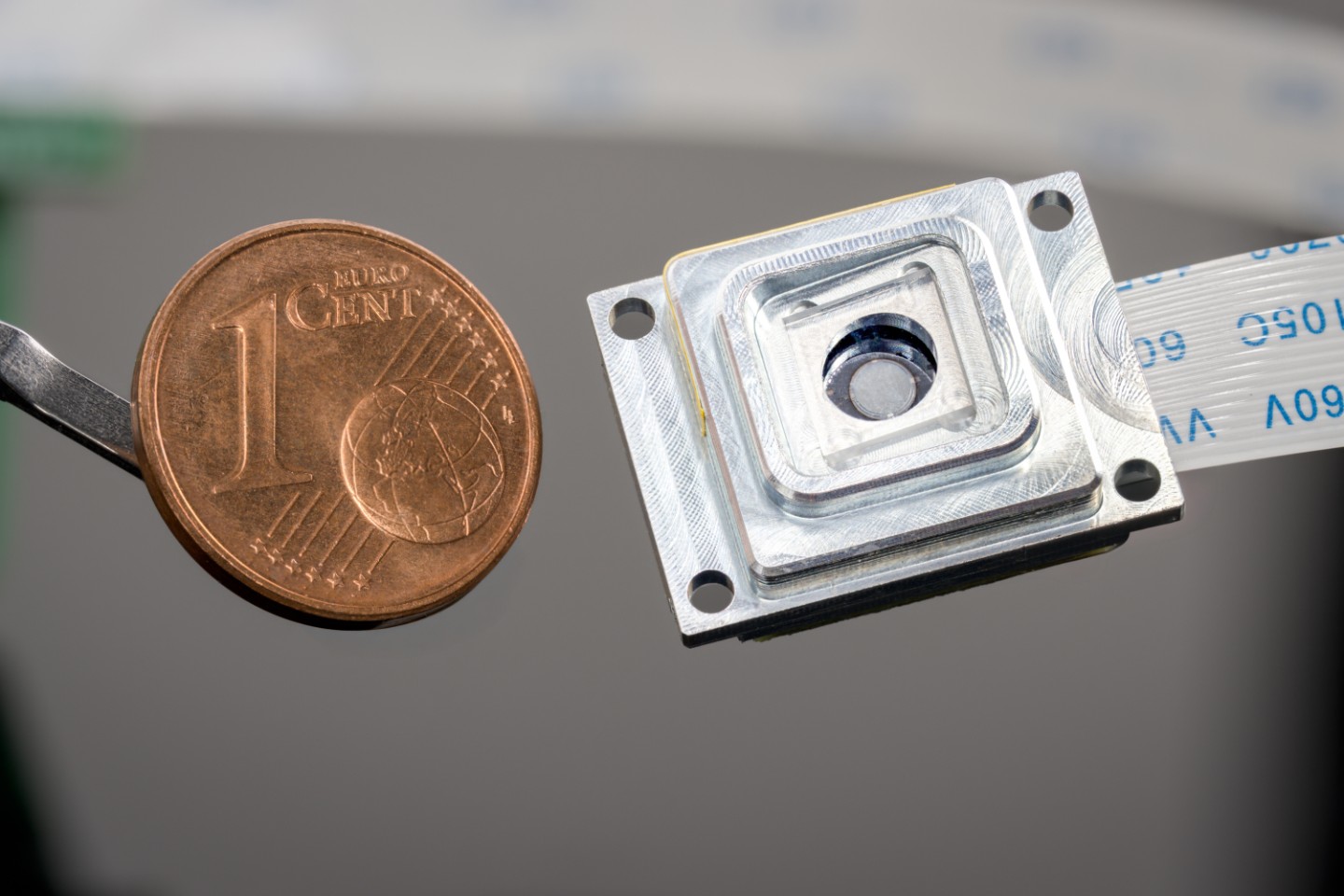
Medical lasers have become indispensable in many areas of healthcare, whether in ophthalmology for correcting vision defects or in dermatology for removing pigmentation disorders and tattoos. The newly developed microscan module, specifically designed for treating retinal diseases and glaucoma, sets new standards in miniaturization and resolution.
In the UltraLase project, another milestone has been reached: The ultra-compact and hermetically sealed optical housing of the microscan with integrated position detection is operational. The use of the MEMS scanner from Fraunhofer IPMS enables unprecedented miniaturization and higher resolution.
“Our highly miniaturized MEMS scan module features an electrostatically driven 2D vector scanner with integrated position sensing. The MEMS mirror, coated with a highly reflective layer, achieves reflectivity of over 98% in the visible range,” explains Dr. Thilo Sandner, Head of Active Microoptical Components & Systems at Fraunhofer IPMS. “Thanks to a tilted window, disturbing light reflections in the field of view are avoided.”
The combination of high-precision MEMS scanner mirrors and position sensing in a compact hermetically sealed housing posed a unique challenge that has been successfully mastered. The robust modules are ideal for portable applications and enable precise and highly dynamic positioning of the laser – crucial for safety-relevant procedures, especially in ophthalmology. The scan module is complemented by the compact driver electronics VECDRES developed at Fraunhofer IPMS, which allows for controlled or regulated operation of the MEMS scanner using integrated position sensing.
With the UltraLase project, which will be completed by the end of May 2026, the innovative components are ready for practical implementation or adaptation to further applications. Fraunhofer IPMS looks forward to customer- and application-specific projects to further advance the future of laser medical applications.
The institute thanks the industrial partners Norlase and OptiKron for their excellent collaboration and valuable contributions of their system and application knowledge. These contributions were crucial for the development of the module.
