 Fraunhofer Institute for Photonic Microsystems
Innovative sensor technology for sustainable transformation in Lusatia
Duration: 2025 - 2030

Lusatia is undergoing structural change, transitioning from a coal-based economy to a more sustainable energy industry. In addition to the fragmented business landscape, the renaturation of the post-lignite landscape and the conversion of the energy supply to green technologies pose a challenge. High technologies must support this sustainability development and represent an opportunity to strengthen the local economic landscape.
Through research and development in both environmental and hydrogen sensor technology, the AIS-EN project is making an important contribution and giving local companies access to technological solutions that enable them to actively shape structural change in a positive way and take advantage of opportunities arising from the region's transformation processes.
The overall objectives of the project are:
- Provision and transfer of innovative sensor technology for companies
- Rapid, local detection of environmental pollutants in soil, wastewater, and water bodies
- Safe hydrogen monitoring for the hydrogen economy of the future
The research work is being carried out in Cottbus and is based on the structures and expertise developed by the Integrated Silicon Systems (ISS) institute branch of Fraunhofer IPMS.
Project 1 – Smart environmental monitoring for wastewater treatment, soil, and water
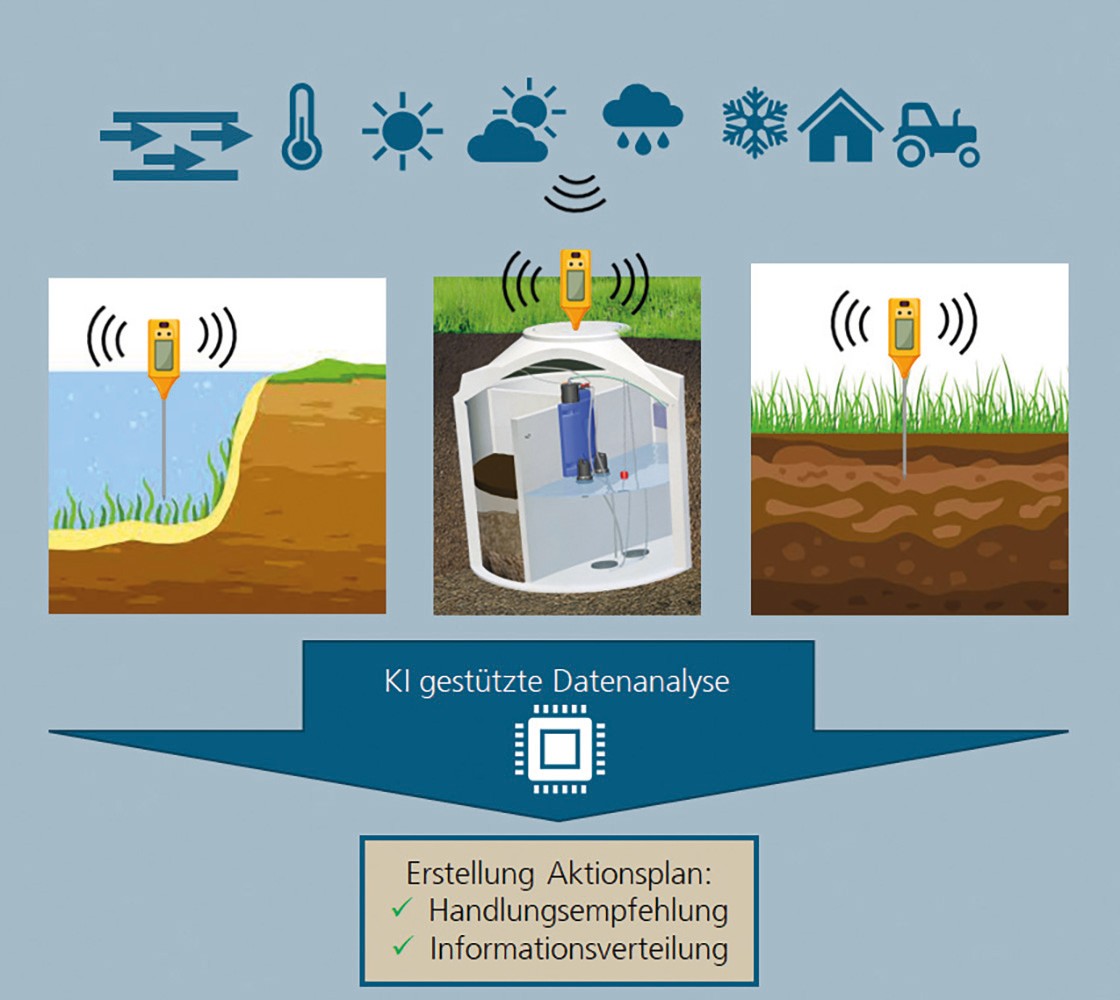
There are several important reasons for monitoring soil and water quality in Lusatia. The main cause for this is the long-standing lignite mining in the region, which has led to water acidification and pollution. Until now, environmental parameters such as pH value or pollutant concentrations have often only been recorded selectively and at long intervals. We are developing a system that continuously measures, collects data in real time, and analyzes and evaluates it with the help of AI.
Solid-state sensors are used, which deliver reliable results regardless of turbidity in soil and water. The sensor technology is supplemented by AI-supported evaluations that detect anomalies, such as the discharge of toxic substances, at an early stage, link them to historical and meteorological data, and use this information to derive forecasts and recommendations for action. The aim is to ensure the long-term quality of groundwater and enable a rapid response to environmental pollution..
Project 2 – Hydrogen safety monitoring
A second focus is on developing a novel safety monitoring system for the hydrogen economy. As hydrogen becomes increasingly important as an energy source, risks such as leaks must be reliably detected.
The ultrasonic sensors developed in the project enable fast, continuous, and precise detection across a comprehensive concentration range from 1% to 100%. They are characterized by high temperature stability and low maintenance requirements, as they operate reliably without regular calibration. In addition, they achieve a measurement accuracy of less than two percent. In addition to the safe monitoring of explosion limits, the spatial distribution of hydrogen in the sensor's detection range is also detected. This makes it possible to determine the spatial origin of a hydrogen leak. The AI-supported evaluation increases measurement accuracy, robustness, and long-term stability. Thanks to the high degree of integration and CMOS-compatible manufacturing processes, electronic components can also be integrated directly with the sensor.
Cooperation and Local Support
For the AIS-EN project, Fraunhofer IPMS receives support from the following regional partners:
- LKT Lausitzer Klärtechnik GmbH
- UP Umweltanalytische Produkte GmbH
- PRIGNITZ Mikrosystemtechnik GmbH
- Actemium BEA GmbH
- GST Gesellschaft für System- und Tankanlagentechnik mbH
Additionally, more than ten other companies and associations have confirmed their support through letters of intent (LOIs). These collaborations are crucial to ensuring technology transfer to the region and strengthening Lusatia's innovation and competitiveness in the long term. The five-year project is funded by the Federal Ministry of Research, Technology and Space with approximately 7 million euros.